



TL;DR:
- Shopify is the managed apartment. WooCommerce is the house you own. Shopify handles hosting, security, and updates for you. WooCommerce gives you full control but you manage (and pay for) everything yourself.
- Total Year 1 cost is surprisingly similar: Shopify runs $3,400 to $17,000+, WooCommerce runs $3,700 to $15,500+. The real cost difference shows up in ongoing maintenance, developer time, and your own hours.
- Quick Answer: Choose Shopify if you want a hands-off, fast-to-launch store. Choose WooCommerce if you need deep customization, full code ownership, and tight cost control at scale.
Table of Contents
Shopify vs WooCommerce 2026. It’s the question every business owner eventually asks when building an online store. And the answer you get depends entirely on who you ask.
Ask a hosting company, and they’ll push WooCommerce (because they sell hosting). Ask a Shopify partner, and they’ll push Shopify (because they earn commissions). Neither gives you the full picture.
At BK Web Designs, we build on both platforms. Over the past decade, we’ve delivered 150+ Shopify stores and 200+ WordPress/WooCommerce sites. We profit the same either way, which means we have zero reason to push one over the other. What we care about is recommending the right platform for your situation.
This guide compares the real total cost of ownership for both platforms, including the costs nobody talks about: your time managing updates, developer fees for small changes, plugin bloat, and security maintenance. We end with a clear decision framework so you can stop researching and start building.
Shopify vs WooCommerce 2026: What Are They, Really?
Before we compare costs, let’s make sure we’re clear on what each platform actually is. They’re fundamentally different products that solve the same problem in different ways.
Shopify: The All-in-One Managed Platform
Shopify is a hosted, all-in-one ecommerce platform. You pay a monthly subscription and get everything bundled: hosting, security, SSL, payment processing, and a store builder. Think of it like renting a fully furnished apartment. You move in, arrange your furniture, and start living. The landlord handles plumbing, electricity, and maintenance.
Shopify powers approximately 4.8 million active storefronts globally, with roughly 3 million based in the United States. Its App Store offers over 13,000 apps to extend functionality. It’s the dominant platform among high-traffic stores, holding 28.8% of the top 1 million ecommerce sites.
WooCommerce: The Open-Source Powerhouse
WooCommerce is a free, open-source plugin that turns any WordPress website into a full ecommerce store. It’s not a standalone product. You install it on WordPress, which means you need your own hosting, your own security, and your own technical maintenance. Think of it like buying a house. You own everything, control everything, and maintain everything.
WooCommerce powers over 4.5 million active stores tracked by StoreLeads and holds between 20 to 33% of global ecommerce market share depending on the measurement methodology. Its strength lies in the WordPress ecosystem: access to 60,000+ plugins, full code ownership, and unlimited customization possibilities.
📥 Free Resource: Not sure which platform fits your business? Download our free 27-Point E-Commerce Conversion Checklist. It works for both Shopify and WooCommerce stores.
Download Free Checklist →
Feature-by-Feature Comparison: Shopify vs WooCommerce
Here’s a side-by-side breakdown of how the two platforms compare on the features that matter most to store owners. No spin, just facts.
| Feature | Shopify | WooCommerce |
|---|---|---|
| Hosting | Included in every plan | You manage ($25 to $100+/mo for managed hosting) |
| Security | Included (PCI DSS Level 1 compliant) | You manage (SSL + firewall + updates + monitoring) |
| Software Updates | Automatic, handled by Shopify | Manual (WordPress core + WooCommerce + plugins + theme) |
| Design Flexibility | Theme-based with Liquid templating | Unlimited (full code access to every file) |
| Payment Processing | Shopify Payments: 2.5 to 2.9% + 30¢ | Any gateway you choose (you control the fees) |
| Apps/Plugins | App Store with 13,000+ apps | Plugin repo with 60,000+ options |
| SEO Capability | Good (built-in basics, some URL limitations) | Excellent (with Rank Math or Yoast, full control) |
| Scalability | Easy: upgrade your plan | Complex: upgrade hosting, optimize code, scale server |
| Learning Curve | Low (drag and drop interface) | Medium to High (WordPress knowledge needed) |
| Ownership | You rent the platform (Shopify owns the infrastructure) | You own everything (code, data, server) |
| Best For | “I want it to just work” | “I want full control over everything” |
The pattern is clear. Shopify trades control for convenience. WooCommerce trades convenience for control. Neither is “better.” They serve different business owners with different priorities.

The REAL Total Cost of Ownership (Year 1 and Beyond)
This is where most comparison articles fall short. They list the subscription price and call it a day. But the subscription price is the least important number. Here’s what you’ll actually spend in Year 1 and beyond on each platform.
| Cost Category | Shopify | WooCommerce |
|---|---|---|
| Platform/Hosting | $348 to $3,588/yr ($29 to $299/mo) | $300 to $1,200/yr ($25 to $100/mo managed hosting) |
| Design/Development | $2,500 to $10,000 | $2,000 to $8,000 |
| Apps/Plugins | $600 to $3,600/yr (most apps bill monthly) | $200 to $1,500/yr (many plugins are one-time purchases) |
| Maintenance | $0 (included in platform) | $1,200 to $4,800/yr (or DIY, but your time has a cost) |
| Transaction Fees | 2.5 to 2.9% + 30¢ per sale (Shopify Payments) | Payment gateway fees only (typically 2.9% + 30¢, no platform cut) |
| Year 1 Total | $3,448 to $17,188 | $3,700 to $15,500 |
| Year 2+ Ongoing | $948 to $7,188/yr | $1,700 to $7,500/yr |
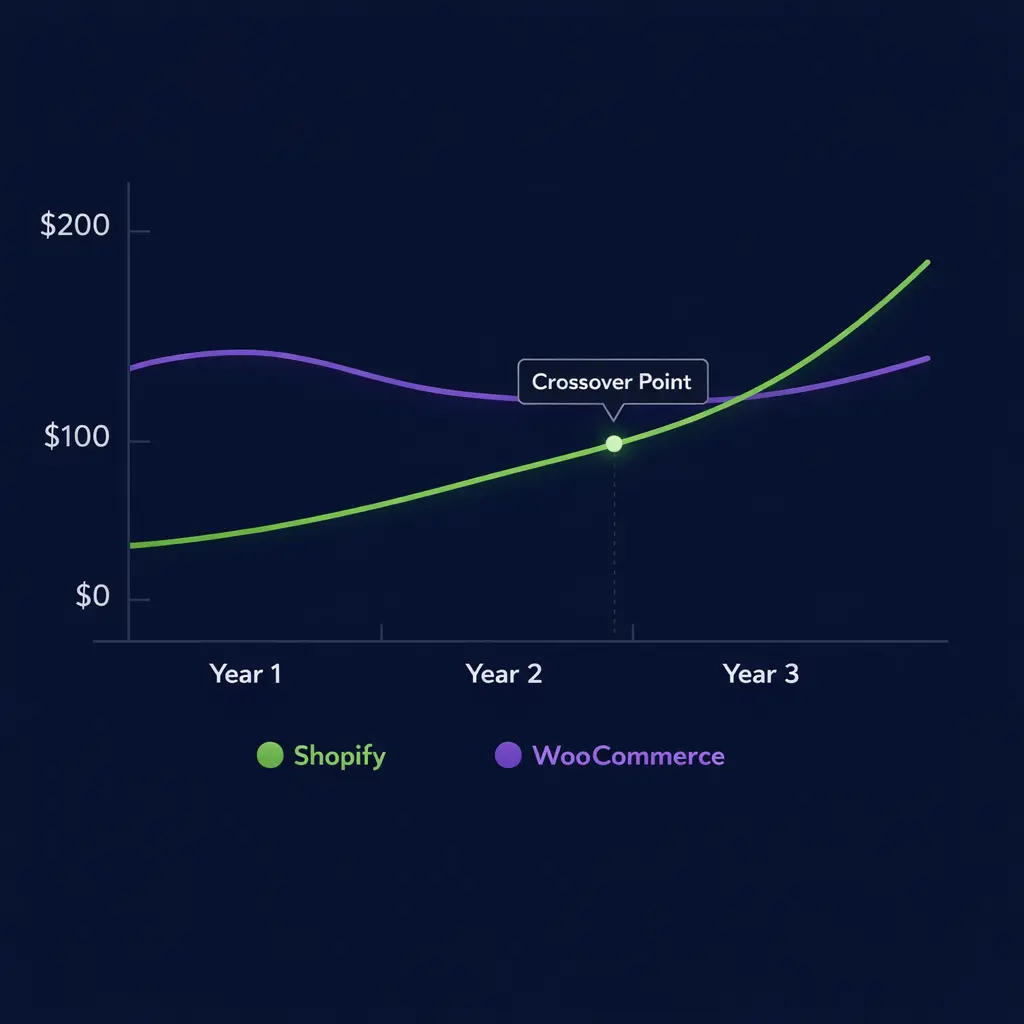
The surprise? Year 1 costs are remarkably similar. The real differences emerge in Year 2 and beyond, where WooCommerce’s ongoing maintenance costs (updates, security monitoring, developer time for fixes) add up, while Shopify’s recurring app subscriptions keep billing you every month.
One critical cost that isn’t in this table: your time. If you’re spending 5 hours a month managing WooCommerce updates, troubleshooting plugin conflicts, and monitoring security, and your time is worth $100/hour, that’s $6,000 a year in hidden labor. Shopify eliminates most of that.
Hidden Costs Nobody Talks About (For Each Platform)
Beyond the line items in the table above, each platform has costs that sneak up on you after launch. We see these catch clients off guard all the time.
Shopify’s Hidden Costs
- App subscription creep. The average Shopify store spends $50 to $300 per month on apps. Most apps bill monthly, so they compound. On a recent client audit, we found a store running 22 apps with 9 of them redundant or unused, costing $225/month in waste.
- Transaction fees on third-party gateways. If you don’t use Shopify Payments, Shopify charges an additional 0.6% to 2.0% on top of your payment processor’s fees. On $10,000/month in revenue, that’s an extra $60 to $200/month.
- Theme limitations. If your design vision exceeds what Shopify’s Liquid templating allows, you’ll need a developer for custom Liquid code. That gets expensive fast.
- Platform lock-in. If you ever leave Shopify, migrating your store, customer data, and order history to another platform is a significant project with real costs ($2,000 to $10,000+ depending on complexity).
WooCommerce’s Hidden Costs
- Maintenance time (or cost). WordPress core, WooCommerce, your theme, and 15 to 25 plugins all need regular updates. One bad update can break your checkout at 2 AM on a Friday. If you’re not doing this yourself, a maintenance plan runs $100 to $400/month.
- Security responsibility. WordPress is the most targeted CMS on the planet (because it’s the most popular). You need a firewall plugin, malware scanning, regular backups, and someone monitoring it all. Shopify handles this automatically.
- Developer dependency for small changes. Want to add a new payment method? Change your checkout layout? Modify how shipping calculates? On WooCommerce, many changes require a developer. At $75 to $150/hour, even “small” changes add up fast.
- Hosting scaling. When your store gets a traffic spike (Black Friday, a viral post), your WooCommerce hosting needs to handle it. Cheap shared hosting will crash. Scaling managed hosting from Kinsta or Cloudways requires planning and additional cost.
When Shopify Is the Right Choice
Based on 10+ years of building stores on both platforms, here are the scenarios where we consistently recommend Shopify.
You Want Speed to Market
If getting your store live quickly matters more than having pixel-perfect customization, Shopify wins. You can have a functional, professional-looking store live in days, not weeks. The platform handles hosting, security, and payments out of the box.
You’re Non-Technical (And Want to Stay That Way)
Shopify’s admin dashboard is genuinely intuitive. Adding products, managing orders, updating content: it all works without any code. On WooCommerce, even “simple” tasks occasionally require touching a functions.php file or debugging a plugin conflict.
You Sell Physical Products and Want Simplicity
For straightforward product-based stores (apparel, accessories, home goods, beauty), Shopify’s built-in features cover 90% of what you need. Inventory management, shipping calculations, tax handling, and abandoned cart emails all work natively. On a recent client project, a DTC skincare brand, we launched their custom Shopify store in 3 weeks. They were processing orders on day one with zero technical hiccups.
You Value Your Time Over Maximum Control
If you’d rather spend your time on marketing, product development, and customer relationships instead of managing hosting and updates, Shopify’s “done for you” infrastructure is worth the premium. Stanford’s Web Credibility Research found that 46.1% of consumers assess website credibility based on visual design alone. A professionally designed store on either platform converts. The question is which platform lets you focus on growing the business.
When WooCommerce Is the Right Choice
And here are the scenarios where WooCommerce consistently makes more sense.
You Need Deep Customization or Complex Product Types
If your store needs custom product configurators, membership systems, subscription models, or multi-vendor marketplace functionality, WooCommerce’s open-source architecture gives you unlimited flexibility. You can modify literally every line of code.
On a recent project, a B2B industrial parts supplier needed customers to request custom quotes on configurable products, with tiered pricing based on volume. WooCommerce let us build exactly what they needed. On Shopify, we would have been limited by the platform’s architecture and fighting against its constraints.
You Have a Developer (Or Are One)
If you have in-house technical talent or a reliable development partner, WooCommerce’s maintenance burden becomes a non-issue. The cost savings and flexibility advantages are real when someone capable is already handling updates, security, and optimization.
SEO and Content Marketing Are Your Primary Growth Strategy
WooCommerce lives inside WordPress, the world’s most powerful content management system. If your growth strategy depends on blogging, content hubs, SEO-driven landing pages, and sophisticated site architecture, WooCommerce integrates content and commerce seamlessly. Shopify’s blogging capabilities exist but are basic by comparison.
You Want Full Ownership and Control Over Costs
With WooCommerce, you own your code, your data, and your server. No platform can raise your subscription price, take a percentage of your sales, or shut down your store for a terms-of-service dispute. Many WooCommerce plugins are one-time purchases rather than monthly subscriptions, which means your costs flatten over time instead of climbing. For cost-conscious businesses building with a professional WooCommerce development team, the long-term savings can be substantial.
The Decision Framework: Choose Based on YOUR Situation
Stop overthinking it. Use this table to find your match.
| Choose Shopify IF… | Choose WooCommerce IF… |
|---|---|
| You want hands-off maintenance | You want 100% ownership and control |
| You’re non-technical or time-poor | You have a developer or enjoy tinkering |
| Speed to market is your priority | Deep customization matters most |
| You sell physical products primarily | You need complex product types or memberships |
| You can budget $50 to $300/mo for apps | You prefer one-time plugin purchase costs |
| You plan to scale quickly and simply | You need tight control over every cost |
| Content marketing is secondary | SEO and content are your growth engine |
| You want 24/7 platform support | You have reliable technical support already |
Still can’t decide? Here’s the simplest test we give our clients: if you got an email at 3 AM saying “your website is down,” would you know what to do? If yes, WooCommerce is on the table. If that email would give you a panic attack, choose Shopify.
Both platforms can power a beautiful, high-converting store. The Stanford Web Credibility Research confirmed that consumers judge business credibility primarily on how a website looks and functions, not which platform runs it behind the scenes. What matters most is the quality of your design, your product pages, and your user experience. If you need help building a conversion-focused store on either platform, explore our ecommerce design services.
Frequently Asked Questions
Is Shopify or WooCommerce cheaper in 2026?
Neither is universally cheaper. Shopify’s Year 1 total cost ranges from $3,400 to $17,000 while WooCommerce ranges from $3,700 to $15,500. WooCommerce has lower platform fees but higher maintenance costs. Shopify has higher app subscription costs but zero maintenance overhead. Your total depends on revenue volume, technical capability, and how you value your own time.
Can I switch from Shopify to WooCommerce later (or vice versa)?
Yes, but it’s not free or easy. Migration involves rebuilding the design, transferring products, redirecting URLs, and moving customer data. Typical migration costs range from $2,000 to $10,000 depending on store size. This is why choosing the right platform upfront matters. If you’re unsure, start with Shopify for speed and migrate to WooCommerce later only if you genuinely need the flexibility.
Which platform is better for SEO in 2026?
WooCommerce has a slight SEO advantage because WordPress offers full URL control, deeper content capabilities, and powerful plugins like Rank Math. That said, Shopify’s SEO has improved significantly and is more than sufficient for most stores. The biggest SEO factor isn’t the platform. It’s the quality of your content, site speed, and technical setup regardless of which platform you choose.
Is WooCommerce really free?
The WooCommerce plugin itself is free. But running a WooCommerce store requires paid hosting ($25 to $100/month), a domain ($10 to $20/year), premium plugins ($200 to $1,500/year), and ongoing maintenance (DIY or $100 to $400/month). The realistic minimum monthly operating cost for a production-ready WooCommerce store is about $25 to $40 per month at the bare minimum, scaling up with your needs.
Which platform do most agencies recommend?
Most agencies recommend whichever platform they specialize in, which creates bias. Hosting companies push WooCommerce because they sell hosting. Shopify partners push Shopify because they earn commissions. At BK Web Designs, we build on both platforms and recommend based solely on your business needs, budget, and technical comfort level. The right platform depends on your situation, not an agency’s business model.
How many stores use Shopify vs WooCommerce in 2026?
Shopify powers approximately 4.8 million active storefronts globally while WooCommerce powers over 4.5 million active stores. However, Shopify dominates among high-traffic, high-revenue stores with 28.8% of the top 1 million ecommerce sites compared to WooCommerce’s 18.2%. WooCommerce has broader total adoption due to WordPress’s massive ecosystem, especially among smaller merchants.
🚀 Need Professional Help?
We build on both Shopify and WooCommerce and can recommend the right platform based on your budget, timeline, and growth plans. Our ecommerce packages start at $2,500 with transparent pricing on either platform.